
Anyone into hip hop culture knows that it’s become a thing for over excited (read: young) fans to label an album a ‘classic’ 15 minutes after its release. Even more expected is the subsequent backlash from old heads like myself, quick to clap back at these substance-less, wave driven youth.

For some reason we don’t find this same reactive dynamic when it comes to literature or film – (perhaps because these forms take longer to digest?), yet despite this apparent fact, I found myself bestowing this title upon Dionne Edwards’ debut feature, Pretty Red Dress, way before the final credits began to roll. It’s been a year since I first saw this movie and I can’t say my feelings have changed.
The movie centres on a black family living in South London. Candice is the somewhat matriarch of the family working a job in retail whilst pursuing her dream of being on stage. Her headstrong daughter, Kenisha (played by an outstanding Temilola Olatunbosun), besides getting in trouble at school, is busy discovering her sexuality. And at the centre of our story is Travis – he’s recently been released from prison, and we soon become curious to find him infatuated with his partner’s red dress.
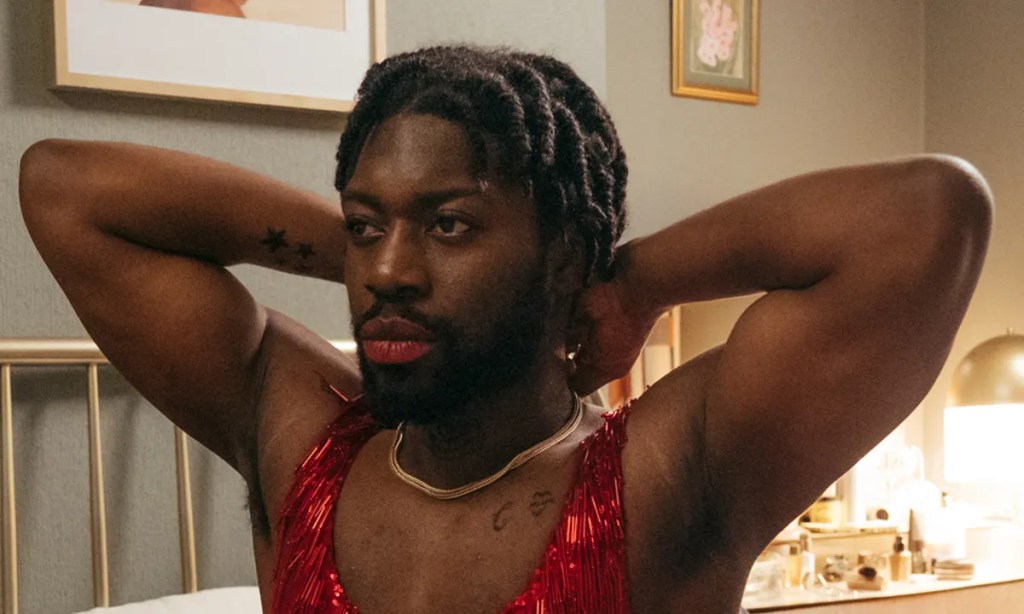
Like all classics, Pretty Red Dress somehow manages to grace you with new impressions each time you watch, yet none of my later reruns quite hit like the first two times. The first showing I watched at Soho House. It was a small private viewing, attended by the lead actor and a mostly black audience. Having no idea what the film was about, the elements of gender, sexuality, and cross dressing came to many of us as a surprise, and the audience’s reaction was expressive of this.
I’m not sure how accurate I am in saying this, but it feels like a part of black culture (or at least Caribbean culture), to be overly vocal about the things we watch. As a young kid, I remember my grandma cussing out the bad guys in Knightrider when it seemed they were going to get one over on Michael, or cheering for Jessica when she once again outsmarted the perpetrator in Murder She Wrote. With these memories to heart, it came as no surprise when I heard someone from the crowd shouting at Travis to ‘take arf di dress nuh man’.




All of this added to the incredibility of this movie for me. Hyped off this first showing, I walked into the BFI three days later (about five black minutes late, I ought to add) – and was taken aback…Firstly to find that our seats had been taken, and secondly that they were taken by white people. As a matter of fact, a quick look around appeared to show that all the seats were taken by white people.

It’s one of those moments that not only did you fail to anticipate, but wouldn’t even have expected to trigger a response. This wasn’t Black Panther or some slave movie, or a Jordan Peele flick where you anticipate the undertones. Pretty Red Dress isn’t overly political in any way – it doesn’t shout or feel it has any points to prove. And so, it wasn’t until I was surrounded by an all-white audience that I realised just how black this film was.
Director Dionne Edwards said that the movie was about ‘showing what conversations look like behind closed doors’, and this is exactly how it felt. A black conversation between black people, behind black closed doors! To now be in an environment where these doors were not only left wide open, but populated with white people, felt unexpectedly vulnerable.
What becomes clear throughout the film is that this is a family in the midst of working through their issues. Travis is unable to provide an answer for his desire to cross dress, and in such a state of transition, what he and his family needs is safety. The kind of safety that allows your tongue to slip; to fall, even, into insensitive, rude, or offensive comment (which his partner and daughter do do).

In a simple stroke of genius, Edwards employs a single linguistic device that allows the family to not only encapsulate the complexity of the issue, but to safely navigate around it. Standing at the bus stop together, Kenisha begins to question what Travis is unable to name. It’s at this moment that she calls out his behaviour as being ‘off key’.
The obvious allusion here is to a musical note sung or played incorrectly. But the term is also a black / urban euphemism to signify something odd or out of place. It’s weighty enough to hold the complexity of the issue, but light enough to toss around. Travis laughingly agrees with his daughter, to which she replies, ‘that’s okay, I’m off key too’… And these words seem to fit just right. It’s an incredibly intimate moment that allows the two to truly find each other.
In many ways the film felt like a microcosm of our black British community. It often seems that, as a community, we are not always on the same page of understanding with the wider (read: whiter) British population. What this film made clear to me is that to explore these issues – to explore what they mean for us – requires a level of safety that, for better or worse, needs to be away from the gaze of white people.

A year later I’m reinforced in my feeling that if this film isn’t for black people (which, in reality, I don’t think it is or ought to be), then – at least for me – it feels safer to encounter within the confines of a predominantly black space. When I overheard black people in that first showing carrying on about Travis being ‘narsty’ and ‘to take arf di panty dem’, but by the end of the film exasperations of, ‘allright, allright, enough man, mek him wear what ‘im want’, I smiled. Not out of affiliation for any particular point of view, but that to be present amidst this journey felt like a safe, communal exploration. This movie is for me a definite classic, and one I’ll be revisiting again and again.
Margin Page
Margins Page is a play on its very words. Stories of black people in Britain, both past and present, have often been relegated to the margins of the British canon. This platform attempts to reconfigure this position, serving as a page to help develop, curate and promote black British literature.
Got a point of view or a story to share? Get involved by clicking here
 marginspage.com