
For anyone who’s seen Tupac’s infamous MTV interview (‘infamous’! aren’t they all?), where he’s talking about the incredulous reality of poverty in America, you may recognise the title of this article and the subsequent stages he mockingly sings through traversing black rage in response to being shut out by ‘mainstream society’. His metaphorical, meek Black American plea of ‘we-are-hun-gry, please-let-us-in’, compounds after many years of desperation, ending with him ‘picking the lock, coming through the door blasting!’.
This is always my favourite part of the interview. It’s ‘Pac at his most defiant, relentless self, and it’s even more of a slap considering how, with him, we knew it wasn’t just talk. And although my temperament is closer to that of Benedict Cumberbatch (and my life a thousand times removed from 90’s Black America), I still feel where he’s coming from.
Over on our side of the water, the question of where Black British people sit along the scale of social inclusion still lingers. As far as identity goes it seems we’re in a time of trying to figure this out, yet within the current narrative there seems to be a plea from black British people, ever so slight, to be let in. Or perhaps more precisely, to be recognised for what we inherently are.
Is this our British way of politely picking the locks to a society and culture that feels distant and abject? And if so, is it working? The conversation surrounding the position of ethnic minority people in this country has never been more prevalent. Added to this is the fact that we have individuals who are prominent enough to, at least on a representational level, do just that – represent.
There seems to be a plea, to be let in. Is this our British way of politely picking the locks to a society and culture that feels distant and abject?
Yet this being observed, we are also able to see that in pretty much all industries, black and ethnic minorities are underrepresented. Black people are still at the foot of the social ladder possessing the poorest levels of social equity in the country.
In British literature, its not that black people are so much underrepresented as not even present. Yet, despite the industry being extremely white, there are more publications out now written by or about the experiences of ethnic minorities than ever before (the problematic nature of this dynamic is for further consideration).
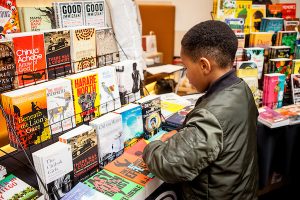
It seems apparent that, in this moment, ethnic minorities are being selectively ushered into the room, however are yet to have a real seat at the table. For whatever progress minority people are making in this country it’s difficult to ascertain what all of this means or to offer any reasonable diagnostic on where we stand.
What exactly did Stormzy’s performance at Glastonbury mean for black British representation? What does Priti Patel’s promotion to Secretary of State mean to the representation of British Asian people? And who knows just how these narratives feed back into the communities from which these people come.
With the influence of technology the question now begins to beg as to what extent we need permission to be ‘let in’. Are we not in a time where we can do it for ourselves? What technology has thus failed to strip away or reconfigure is the structural reconnaissance that upholds power; that to have access to said power the same barriers remain in place. And so until this changes, we’ll keep banging down the door (or, as it were, politely knocking).
Margin Page.
Margins Page is a play on its very words. Stories of black people in Britain, both past and present, have often been relegated to the margins of the British canon. This platform attempts to reconfigure this position, serving as a page to help develop, curate and promote black British literature.
Got a point of view or a story to share? Get involved by clicking here

 marginspage.com