
I can’t remember anyone actually ever telling me this. Yet as I write these words the statement feels like… well, just that – a statement. A solidified and somehow factual thing.
Growing up for me? reading was something akin to masturbation – a shameful act to be conducted in private. Yet thinking about it, it would be more accurate for me to say that reading developed into something shameful. I hadn’t always felt this way.
Growing up for me reading was akin to masturbation – a shameful act to be conducted in private
I was once proud of my inner nerd. Reading big fat books, learning big fat words, helped me to take my mind off what people thought was my big fat belly (it was, to be fair, quite big).
Yet around the age of fifteen, something you won’t need to guess stripped me of this strange sense of pride. No, not the discovery of sex. Well, yes, that too (kind of) but what really gripped me by the throat was the need to fit in, the need to be cool.
For your information (though I doubt you require it), there are few better ways to isolate yourself as a young black boy than by being a book reading nerd. But again, I don’t remember anyone ever telling me this.
As a young black boy there are few better ways to isolate yourself than by being a book reading nerd

Other things were more obvious back then. Wack trainers? You got dissed. Breath stank? You were getting dissed. Everything about your mother? Dissed. Yet, there was never a time in all my years that I recall any kid getting knocked about for believing in Harry Potter. It just didn’t happen.
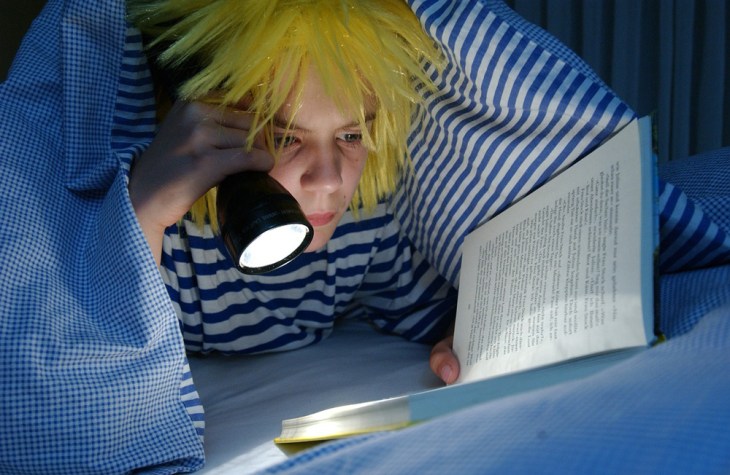
But then again, who would have known? It’s not like we were promoting book club or anything. My reading I conducted like an MI5 spy searching for clues between the pages of Malorie Blackman.
On the road I’d bop my way to college, tracky bottoms sagged low, only to return home to cuddle up with Tolstoy for the night
And whilst it’d be an exaggeration for me to posture some kind of double life, it was in this vein that I spent my formative years; living my passion for books and art entirely within the confines of my head.
Where’d this inclination to keep my lives separate come from? And how’d it manifest in me so strongly?
Our culture of anti-intellectualism can make reading seem tantamount to a physical beating.

But let’s return to our slogan. It’s black boys who don’t read. Where, if it exists, is the racial element in all of this?
Those in hiding aside, if there is any truth to this statement, I think it manifests as an offshoot reverberation of the larger concept of blackness and its effects on young black boys everywhere.
Reading, in a way, represents the very antithesis of a very specific yet extremely prevalent portrayal of blackness that many young boys settle into, or strive restlessly to attain. With a sustained narrative of black men being hyper-masculine, hyper-sexualised, super-cool real niggers, where in these transgressions is there space for the sensitivity, understanding and contemplation that reading represents?
This is not to suggest that both cannot survive in one body. They can. But we must remember that our subject is young boys and the formative years in which they try to carve out an identity for themselves, one that feels acceptable (or, at times, unacceptable), but perhaps most significantly, one that feels singular.
Back then it was extremely difficult for me to allow myself to be seen in varied ways, especially those that did not conform to the standards of blackness I’d come to accept.
The journalist Danyal Smith has a quote which runs, ‘across the diaspora young people everywhere are trading complex identities for tribal affiliations’. I read this as a warning, as a gentle reminder for us to hold on to, and care for our complexities, conflations and contradictions. After all, isn’t it this that makes us human?
Margin Page.
Margins Page is a play on its very words. Stories of black people in Britain, both past and present, have often been relegated to the margins of the British canon. This platform attempts to reconfigure this position, serving as a page to help develop, curate and promote black British literature.
Got a point of view or a story to share? Get involved by clicking here

 marginspage.com